Figures supplied by the owner
NAD+ 500 mg
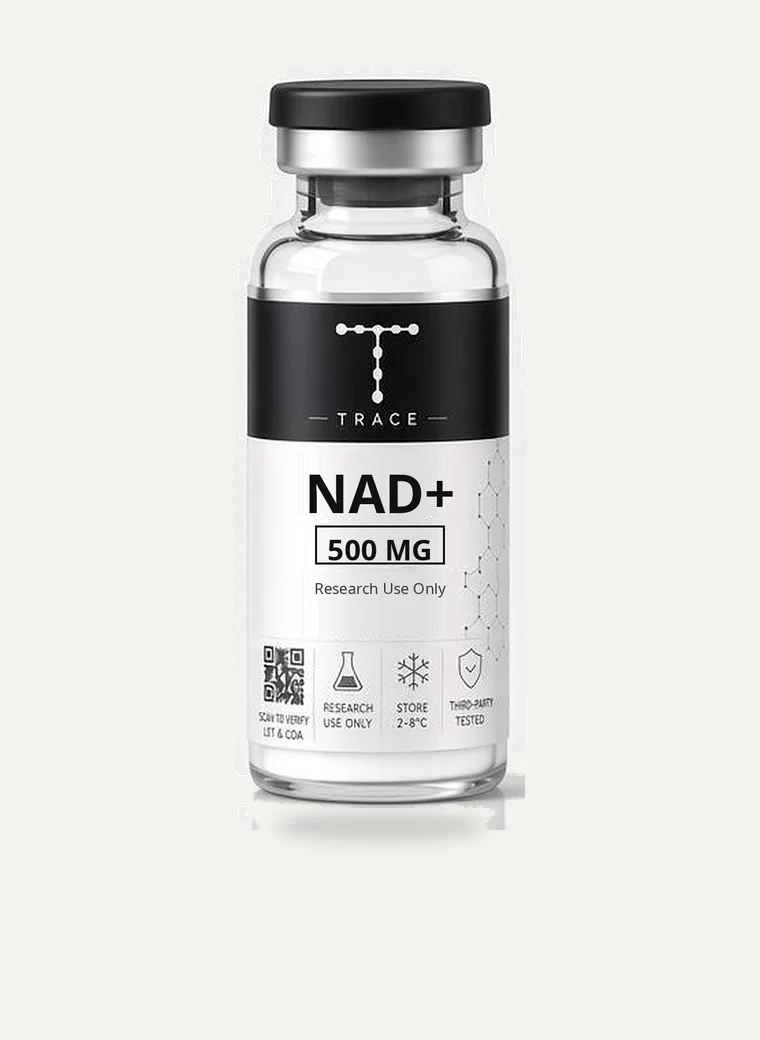
NAD+. 500 mg vial.
Bacteriostatic water
Concentration: 100 mg/mL
| mg | mL | Concentration | |
|---|---|---|---|
| 500 | Add 5.0 mL | 100 mg/mL | In the catalog |
For 500 mg, 5 mL is cited (100 mg/mL), sometimes in a larger amber vial. Another row from the same source uses 10 mL (50 mg/mL). A 3 mL vial cannot hold 5 mL.
Check that the vial can hold this volume and still leave room to mix. A reference figure does not fit every glass.
Prepare the vial
- Let the vial and the bacteriostatic water reach room temperature.
- Swab both stoppers and let them dry.
- Measure the volume of bacteriostatic water stated for that vial.
- Add the water slowly down the inside wall of the glass. Do not spray it onto the powder.
- Swirl gently until dissolved. Do not shake.
- Write the date and the concentration in mg/mL on the vial.
- Store refrigerated, between 2 and 8 °C, protected from light. Discard the solution if it looks cloudy, particulate, or a color the sheet does not explain.
Bacteriostatic water contains 0.9% benzyl alcohol as a preservative. Read the diluent label.
Unit breakdown
Arithmetic conversion on a U-100 syringe (100 units = 1 mL). Not a schedule and not a recommended amount.
Concentration (mg/mL) = mg in the vial ÷ mL of water. Volume (mL) = mg ÷ concentration. Units = volume (mL) × 100.
| Amount (mg) | U-100 units | Volume (mL) |
|---|---|---|
| 2.5 | 2.5 | 0.025 |
| 5 | 5 | 0.05 |
| 10 | 10 | 0.1 |
| 15 | 15 | 0.15 |
| 20 | 20 | 0.2 |
| 25 | 25 | 0.25 |
| 30 | 30 | 0.3 |
| 40 | 40 | 0.4 |
| 50 | 50 | 0.5 |
| 60 | 60 | 0.6 |
| 80 | 80 | 0.8 |
| 100 | 100 | 1 |
Sources for the water volume
Only the millilitres and the concentration were taken. Those pages may say other things. TRACE does not reproduce or recommend them.
- Amino Peptides — NAD+ 500 mg + 5.0 mL = 100 mg/mL; also lists 10 mL = 50 mg/mL
- PepCraft — 500 mg + 5 mL = 100 mg/mL
Calculator
Enter three figures. The page returns the concentration and, if you enter an amount in mg, the U-100 units. It does not choose the amount for you.